
The Most Complex Philosophy Book Ever Written
A complete guide to decoding Immanuel Kant's masterpiece, "The Critique of Pure Reason," and the architecture of the human mind.

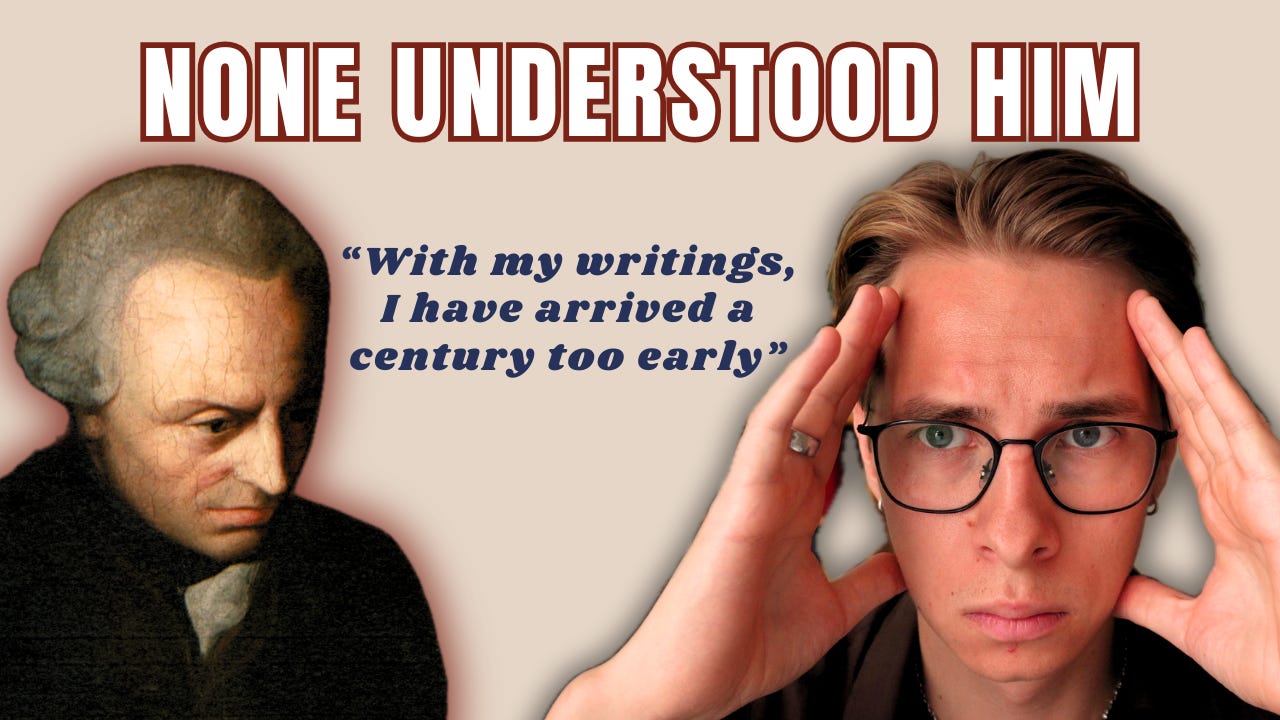
“With my writings, I arrived a century early; only in a hundred years will my work be taken seriously, and then people will return to study and recognize the value of my books.”
Immanuel Kant was absolutely right. When his seminal work, the Critique of Pure Reason, was published in 1781, it was heavily criticized. Today, it is considered one of the most important texts in the history of philosophy.
Even decades later, the greatest minds struggled with it, oscillating between awe and frustration. Let’s look at just a few historical reactions to get an idea:
Moses Mendelssohn: “Kant risks destroying the entire metaphysical tradition! His critique doesn’t build—it annihilates what reason has painstakingly constructed over the centuries.”
Johann Georg Hamann: “The reason Kant claims to defend is a soulless machine. He forgets that thought is born from language, from history, from the flesh of man: without this, it is just an abstract ghost.”
Gottlob Ernst Schulze: “How can Kant argue that we do not know the thing-in-itself, and then assign it the power to cause phenomena? This is a blatant contradiction at the very heart of his system!”
Johann Gottlieb Fichte: “Kant opened the way but stopped halfway. His philosophy remains imprisoned by a dualism that must be overcome: true freedom of the spirit requires a deeper and more unified foundation.”
Georg Wilhelm Friedrich Hegel: “Kantian philosophy is a labyrinth of abstractions, incapable of grasping the concrete. Reason cannot remain confined within the limits Kant imposes: it is historical, dialectical, living.”
Arthur Schopenhauer: “Kant is the greatest of all philosophers… but also the most obscure. His Critique is a brilliant work smothered by barbaric language, scholastic style, and a mountain of avoidable errors.”
These are just some of the observations made about this work. It remains profoundly obscure, yet indispensable because it is rich in fundamental problems. In this article, we will expose the key points that characterize this monumental text, highlighting the true pillars of Kantian thought.
Chapter One: The Structure of the Critique of Pure Reason
Kant’s Critique of Pure Reason, like his other major works, is written in the form of a systematic treatise. This is not just a traditional stylistic choice; it reflects Kant’s belief that philosophy needs to be organized and methodical. For Kant, systematic unity is what turns ordinary knowledge into science.
The Critique is a foundational work for a future complete system of philosophy, where knowledge is divided into two main areas: theoretical knowledge (about nature) and practical knowledge (about freedom). The book itself is highly structured because Reason—the main subject of the book—has an “architectonic” structure; its parts must be explained in an organized way.
The book is divided into two main parts:
Doctrine of Elements: Breaks down reason into its basic components.
Doctrine of Method: Explains how these components are used.
The Doctrine of Elements is further split into:
Transcendental Aesthetic: Deals with how we sense things (sensitivity).
Transcendental Logic: Deals with thinking. This is subdivided into:
Transcendental Analytic: Focuses on understanding.
Transcendental Dialectic: Focuses on reason in the narrow sense.
(Note: The term “transcendental” is used throughout because the book studies the a priori, or inborn, forms of the mind. Therefore, “transcendental” for Kant doesn’t mean floating above the senses, but rather how our mental abilities make knowledge possible.)
Chapter Two: Transcendental Aesthetic
The Transcendental Aesthetic deals with the a priori forms of sensibility, which is our ability to be affected by external objects. According to Kant, all knowledge begins with experience, meaning it starts when our senses are influenced by things outside us. This happens through what he calls intuition, which is a direct (not logical) kind of perception.
While experience gives us the content of knowledge (what we sense), the form—how we are able to receive and organize that content—is given a priori. It exists in the mind before any experience.
So, every intuition has two parts:
The material part: The actual sensation.
The formal part: The mental structure that makes sensation possible.
The pure intuition is this formal part. When it combines with sensation, it becomes an empirical intuition (actual experience). Kant identifies space and time as the two pure intuitions:
Space is the form of outer sense (how we perceive external things).
Time is the form of inner sense (how we perceive our inner experiences).
Space and time are not learned from experience or created by thinking. Instead, they are inborn ways the mind structures all experience. Everything we perceive must appear in space and time, which is why we can only know things as they appear to us (these appearances are called phenomena), not as they are in themselves. Also, since external things are experienced by us in time as well as space, time is actually the pure intuition of all phenomena.
Finally, Kant explains that mathematics depends entirely on these pure intuitions:
Arithmetic is based on the intuition of time (because numbers follow one another).
Geometry is based on the intuition of space (because we construct shapes through imagining spatial movement).
Chapter Three: Transcendental Analytic of Concepts
Empirical intuitions by themselves do not yet constitute true knowledge. They are just a collection of sensory data lacking the connection needed to form an object of knowledge. The mind’s faculty that unifies this data into coherent objects is the Intellect (Understanding), which operates not by direct intuitions but through concepts—discursive representations that organize multiple perceptions under a common idea.
The act by which concepts unify representations is called judgment; thus, thinking always involves judging.
The first part of Kant’s Transcendental Analytic studies the a priori forms of the intellect. The intellect’s unifying function depends on pure concepts that exist prior to experience. Kant calls these pure concepts Categories, as they define the universal ways of thinking (just as Aristotle’s categories defined universal modes of being).
Notably, in the category of relation, Kant includes substance and cause—concepts previously rejected by empiricists like Locke and Hume as metaphysical and illegitimate. Kant rehabilitates them, not as metaphysical realities, but as a prioriforms essential for structuring experience and making scientific knowledge possible.
However, a problem arises: How can these pure, subjective intellectual forms produce knowledge that is universally valid and objective?
Kant answers this in the Transcendental Deduction of the Categories (where “deduction” means “legal justification”). He argues that since every thought requires unifying intuitions, there must be an original unity underlying all acts of unification. This unity is found in the self-awareness of the subject, expressed as the “I think” (the transcendental apperception).
The “I think” must accompany all representations for them to be thought at all. Since the “I think” is identically structured in all thinking subjects, the unification it provides ensures universal and objective validity.
Categories are valid only when applied to empirical intuitions (the realm of experience). Applied beyond this realm, in pure thought without reference to experience, categories produce metaphysical errors and illusions. The thing-in-itself remains unknowable since it cannot be intuitively given or categorized. It can only be thought as a limiting concept called the noumenon—a negative idea that helps define the possibility of phenomena by contrast.
Chapter Four: Transcendental Analytic of Principles
What remains to be explained is how these intellectual categories can actually be applied to sensory intuitions to produce judgments of experience. This is the focus of the Analytic of Principles.
This problem is addressed through Transcendental Schematism, whose purpose is to find a middle term compatible with both the sensory nature of intuitions and the intellectual nature of categories. This middle term is provided by pure (or productive) Imagination.
Imagination allows us to structure things within specific temporal frameworks, such as simultaneity or succession. These “determinations of time according to rules” are called pure transcendental schemata. They act as a bridge: as temporal determinations, they relate to sensibility; as rule-based structures, they relate to the categories.
For example:
The schema of permanence in time corresponds to the category of substance.
The schema of succession corresponds to the category of causality.
The schema of simultaneity corresponds to the category of reciprocal interaction.
These schemata generate the fundamental criteria for any legitimate use of the understanding. These rules are called the pure principles of the understanding, and they fall into four groups:
Axioms of Intuition: All intuitions are extensive magnitudes (they have a quantitative, measurable form). This justifies the use of mathematics in physics.
Anticipations of Perception: In all appearances, the real part that is sensed has an intensive quality (a degree or intensity).
Analogies of Experience: Experience is only possible through necessary connections between perceptions. There are three:
First Analogy: Principle of the permanence of substance.
Second Analogy: Principle of necessary causality.
Third Analogy: Principle of simultaneity under mutual interaction.
Postulates of Empirical Thought: Defines whether an object is possible (fits within space/time/categories), real(corresponds to actual sensation), or necessary (follows universal laws of experience).
This is the culmination of Kant’s Copernican revolution: the lawful and unified structure of nature does not come from the objects themselves, but from the subject. It is the human subject who constitutes nature as a unified field of phenomena governed by necessary laws.
Chapter Five: Transcendental Dialectic
Human reason has a natural tendency to make a “transcendent” use of categories—going beyond the limits of possible experience. Instead of applying categories to limited phenomena, reason tries to form purely logical syntheses, creating concepts of “unconditioned totalities.”
The concepts of absolute totality that reason produces in this transcendent use of categories are called Transcendental Ideas. There are three:
The Soul: The unconditioned unity of the thinking subject.
The World: The unconditioned totality of all phenomena in general.
God: The unconditioned unity of all objects of thought (the ultimate foundation of reality).
These three themes are the core of traditional metaphysics. Kant’s critique shows that attempting to know the essence of the soul, the world, and God arises from the illusion of extending pure thought beyond experience. Each transcendental idea suffers from a different kind of error:
The idea of the Soul is based on a paralogism—a faulty argument that wrongly applies the category of substance to the formal “I think,” falsely deducing the soul’s existence as a spiritual substance.
The idea of the World leads to antinomies—pairs of contradictory statements that both seem logically valid (e.g., The world is finite vs. The world is infinite; Everything is determined by laws vs. There is freedom). They present a contradiction because the “world” is taken as an object beyond experience.
The idea of God has historically been supported by three proofs (Ontological, Cosmological, Physico-theological). Kant critiques all three. The ontological proof fails because existence is not a predicate (it doesn’t add anything to the concept of a being). The other proofs fail because they secretly rely on the ontological one.
Still, Kant insists that transcendental ideas are not meaningless. On the contrary, they play an important regulative role. The idea of an unconditioned totality helps guide reason in organizing knowledge systematically, much like seeing the whole image on a box when assembling the pieces of a mosaic. These ideas should never be used as sources of actual knowledge, but only in a heuristic way to guide inquiry and systematization.
I’m Ivan, and this is Empyreon, the academy of philosophy and fine arts. Thank you for reading.